This blog post was inspired by an article from The Art Newspaper.
Few artists have shaped modern art as profoundly as Pablo Picasso. Born in Málaga, Spain in 1881, Picasso became one of the most influential artists of the 20th century and a pioneer of modern artistic movements.

Over a career that spanned more than seven decades, he worked as a painter, sculptor, printmaker, ceramicist, and stage designer, producing thousands of works that transformed how artists approach form, perspective, and expression.
Picasso is perhaps best known for co-founding Cubism alongside Georges Braque, a revolutionary style that broke objects into fragmented geometric forms to show multiple perspectives at once. His work constantly evolved through different phases—from the emotional Blue Period to the experimentation of Cubism and beyond—cementing his legacy as one of the most innovative figures in art history.
Among his most famous works is Guernica (1937), a monumental anti-war painting created in response to the bombing of the Spanish town of Guernica during the Spanish Civil War.

The painting’s dramatic imagery—screaming figures, a fallen soldier, and wounded animals—captures the chaos and suffering of war and remains one of the most powerful political artworks ever created.
Yet despite Picasso’s reputation as a radical modernist and outspoken atheist, a new exhibition in Spain is shedding light on a lesser-known influence behind his work: religious imagery and spirituality.
The exhibition, “Picasso: Biblical Roots,” is currently on display in the Gothic cathedral of Burgos, bringing together 44 works spanning six decades of Picasso’s career. Remarkably, it is the first time Picasso’s work has ever been exhibited inside a cathedral—an especially symbolic setting given his complicated relationship with religion.
Although Picasso rejected organized religion as an adult, he was raised in a deeply Catholic environment in Spain, and traces of that early influence appear throughout his work. According to the exhibition’s curators, biblical symbolism remained embedded in his artistic imagination long after he distanced himself from church doctrine.
Several pieces in the exhibition reveal these spiritual echoes. One of Picasso’s early works, The Altar Boy (1896), depicts a young boy lighting a candle, reflecting the devotional imagery common in Spanish religious art.
Another painting, Maternity (1921), portrays Picasso’s wife and child in a composition reminiscent of the traditional Virgin and Child motif.

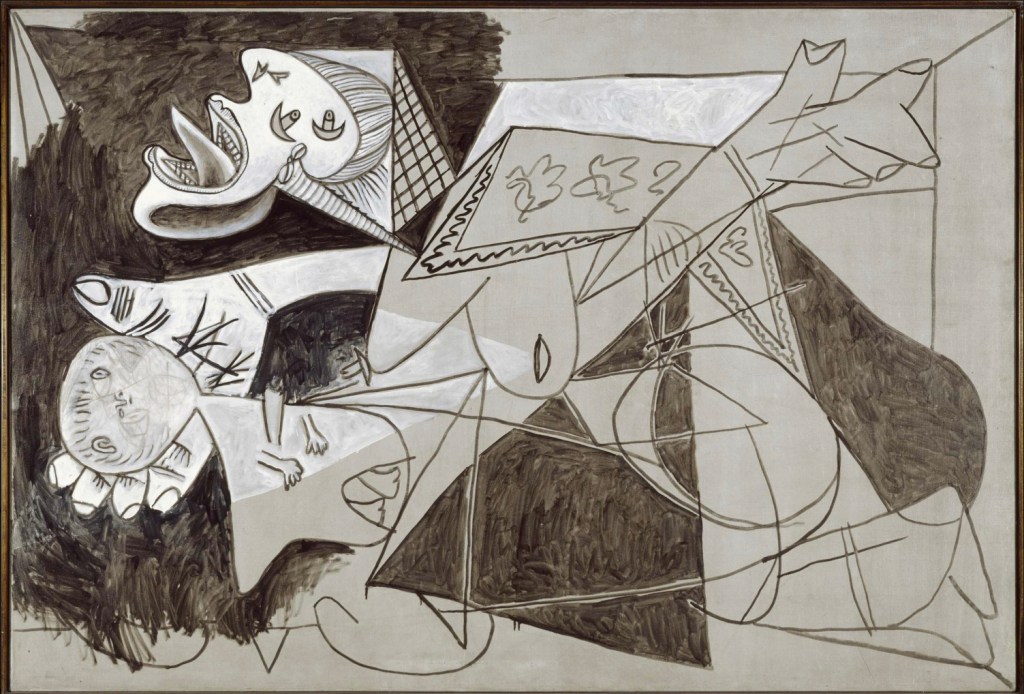
The exhibition also highlights works from the turbulent years surrounding World War II, when Picasso explored themes of suffering, sacrifice, and hope. His piece Mother with Dead Child (II)—a companion to the period of Guernica—evokes the emotional intensity of the Pietà, the Christian image of Mary mourning Christ. Meanwhile, his recurring drawings of doves reference the biblical story of Noah and symbolize peace and renewal.
Even during the Nazi occupation of Paris, Picasso returned to biblical symbolism. His sculpture Man with a Lamb echoes the image of Christ as the Good Shepherd, reflecting themes of protection, compassion, and redemption.

What this exhibition ultimately reveals is that Picasso’s art was shaped not only by politics, experimentation, and modernity—but also by the cultural and spiritual memories of his upbringing. As one curator described it, Picasso may have rejected religious dogma, but spirituality remained woven into his artistic sensibility.
The result is a fascinating reminder that even the most revolutionary artists carry echoes of their past. Picasso’s work may have transformed modern art, but its emotional power was often rooted in timeless human themes—faith, suffering, hope, and the search for meaning.

You must be logged in to post a comment.